
Acupuncture ‘Cun’ Body-Inch Converter
Use your own body as the reference point. Enter your thumb width, choose a target cun distance, and get an instant physical measurement for self-acupressure and educational wellness use.
Personal Calibration Tool
Measure the width of your thumb at the knuckle to estimate 1 cun.
Simple starter distances for learning finger-based measurement.
Useful all-purpose distances often seen in educational point descriptions.
Preset distances handy for arm and wrist learning pages.
Preset distances useful for educational lower-leg point references.
Use the breadth of four fingers together as a quick practical guide.
Quick Reference: Finger Cun
| Hand Measurement | Cun Value | Common Use |
|---|---|---|
| Thumb Width | 1.0 Cun | Local point finding |
| Index + Middle Finger | 1.5 Cun | Short offsets from landmarks |
| Three Fingers Together | 2.0 Cun | Wrist and forearm learning |
| Four Finger Breadth | 3.0 Cun | Lower-leg and larger offsets |
Precision Checklist
About Cun Measurement
In Traditional Chinese Medicine, cun is a proportional body measurement rather than a single fixed universal length. That is why the same cun distance can translate differently from one person to another.
This makes body-based calibration useful for educational acupressure content, point-location learning, and general reference on wellness sites.
P6 / Neiguan
A classic wrist-and-forearm learning example.
Start at the inner wrist crease.
Measure 2 cun up the inner forearm, between the two central tendons.
With the palm facing up, keep the forearm relaxed and compare both sides gently.
Commonly taught in self-acupressure learning for calm and settling support.
Caution: Educational wellness reference only. If pain, numbness, or uncertainty occurs, stop and seek professional advice.
How to Use Cun to Find Acupressure Points
Yes — cun can be used to help locate many acupressure points. The safest and most useful way is to combine a clear body landmark with your own personal cun measurement.
Use a clear structure such as a wrist crease, kneecap edge, ankle bone, elbow crease, or the border of the shin bone.
If a point is described as 2 cun above the wrist crease, use the converter to turn your personal 2 cun into centimetres or inches.
Keep the area relaxed and follow the line described in the point reference rather than stretching the skin tightly.
Compare both sides of the body and look for a naturally responsive or slightly tender spot rather than pressing hard.
Example learning reference: P6 / Neiguan
Often taught as 2 cun above the wrist crease, between the central forearm tendons. This is a useful example for a wrist-and-forearm article using the wrist_forearm preset group.
Example learning reference: ST36 / Zusanli
Often described as 3 cun below the lower border of the kneecap, slightly lateral to the tibia. This makes a good lower-leg demo for the lower_leg preset group.
Example learning reference: Local 1-cun points
Some simple educational point guides use a 1 cun offset from a landmark. The beginner group is useful for these shorter distances.
Important: point descriptions vary slightly across traditions and training systems. This section is for educational acupressure learning only and should not replace practitioner guidance.
FAQ
What is a cun?
A cun is a body-based proportional measurement used in acupuncture and acupressure.
How do I use cun to find a point?
Start from a clear landmark, convert the stated cun distance using your own body measurement, and then measure gently along the described line or region.
What do the preset groups do?
Preset groups help tailor the tool to specific article types, such as beginner explainers, wrist-and-forearm guides, or lower-leg point pages.
What does the point pack panel do?
It turns the converter into an article-specific teaching aid by pairing the calculator with landmark notes, a recommended cun distance, and quick finding tips for one featured point.
Can I use this for treatment?
No. This is an educational self-help tool, not a replacement for professional care.
Acupuncture Cun
The cun (Chinese: 寸; pinyin: cùn; Wade-Giles: ts’un) is a traditional Chinese unit of length. Its traditional measure is the width of a person’s thumb at the knuckle, whereas the width of the two forefingers denotes 1.5 cun and the width of all fingers side-by-side is three cuns. In this sense it continues to be used to chart acupuncture points on the human body in various uses of traditional Chinese medicine.
The cun was part of a larger system, and represented one-tenth of a chi (Chinese foot). In time the lengths were standardized, and in Hong Kong, using the traditional standard, it measures ~3.715 cm (~1.463 in). In the twentieth century in the Republic of China, the lengths were standardized to fit with the metric system, and in current usage in China and Taiwan it measures 31⁄3 cm (~1.312 in).
How does Cun relate to acupuncture
As a unit for measuring acupoints on the body, 1 cun (寸) equals the width of a human thumb’s finger; this is known as the body-based cun. This type of cun is only applicable for measuring acupoints on a person’s own body, meaning that each individual has a unique cun measurement. For instance, Yao Ming’s 1 cun cannot be used to measure 1 cun or acupoints on a child’s body.
| Inches in TCM | Millimeter |
| 0.5 cun寸 | 15 mm |
| 1 cun寸 | 25 mm |
| 1.5 cun寸 | 40 mm |
| 2 cun寸 | 50 mm |
| 2.5 cun寸 | 65 mm |
| 3 cun寸 | 75 mm |
| 4 cun寸 | 100 mm |
| 5 cun寸 | 125 mm |
| 6 cun寸 | 150 mm |
* You may have noticed that this ‘1寸cun’ is not twice the length of ‘0.5寸 cun’, and it also differs from the body-sized inch. Generally, ‘1寸cun’ for acupuncture needles is larger than 1 body-based cun for most people.
What exactly is the length of “1 cun”? In clinical practice, the precision of locating an acupoint directly influences its therapeutic effectiveness. For this reason, practitioners have developed a comprehensive set of methods to identify acupoints. These include the bone measurement method, surface landmark method, finger measurement method, and convenient acupoint location techniques. The bone measurement method relies on joints as reference points to measure the size and length of different body parts, then calculates proportions to pinpoint acupoints. This method can be applied regardless of gender, age, height, or weight. For example, the distance from the midpoint of the front hairline to the midpoint of the back hairline equals 12 cun, as does the distance from the elbow crease to the wrist crease.
From the bone measurement method, it’s clear that the length of “1 cun” used in traditional Chinese medicine acupoint location varies between individuals. A tall person’s elbow-to-wrist distance is longer than that of a shorter person. Therefore, in TCM, acupoints aren’t measured using a ruler marked with fixed units on the patient but are based on their bone landmarks. This highlights TCM’s principle of personalized treatment.
Quick Acupoint Location for Home Care
For most people, the bone measurement method is too complex. Simpler approaches like surface landmark location, convenient acupoint location, and finger measurement can be used instead.
The surface landmark method uses natural body features such as the senses, hair, nails, nipples, navel, and muscle indentations to find acupoints. For instance, the navel helps locate the Shenque acupoint, and the midpoint between the nipples locates the Tanzhong acupoint.
The convenient acupoint location method is even simpler; for example, the midpoint between the tips of both ears locates the Baihui acupoint, and the tip of the elbow when the shoulder droops and the elbow bends locates the Zhangmen acupoint.
The finger measurement method uses the patient’s fingers as a standard unit for measuring acupoints. Like the bone measurement method, finger widths and spacing vary among men and women, young and old, tall and short, or overweight and thin individuals. As a result, the exact length of 1 cun or 3 cun measured by this method differs from person to person.
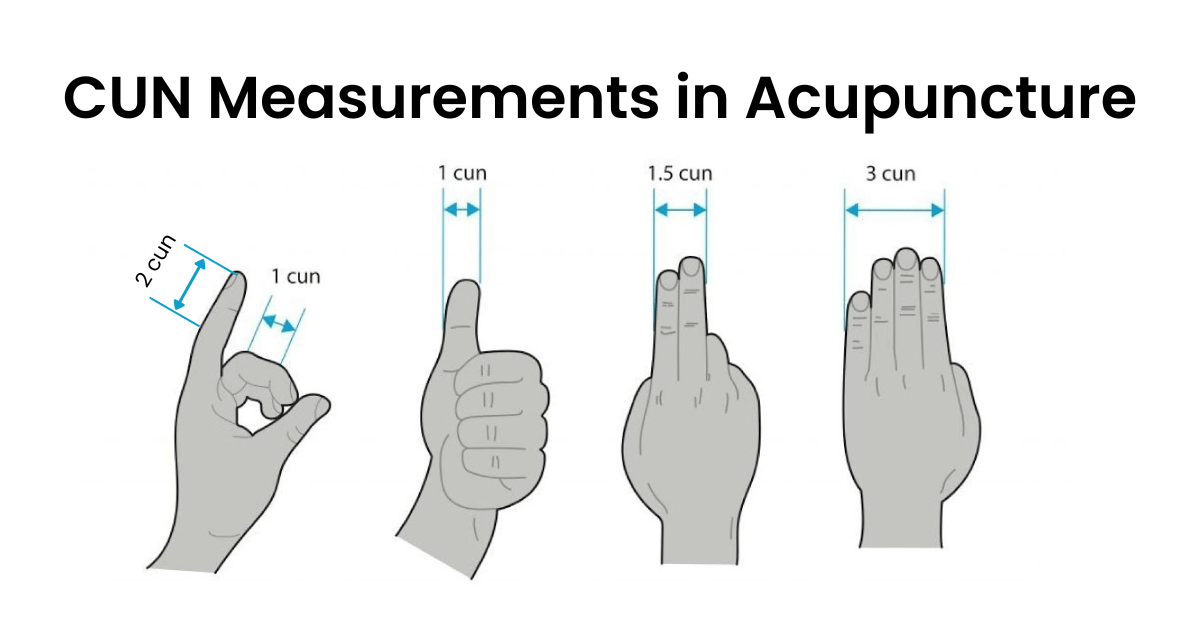
The width of the thumb’s first joint equals 1 cun (寸):
The Essential Prescriptions Worth a Thousand Gold Pieces states: “The first joint of the middle finger is one cun, though its length may vary; therefore, the width of the first joint of the thumb is one cun.” Both the width of the middle finger’s first joint and that of the thumb’s first joint are defined as 1 cun.
The width of four fingers together equals 3 cun (寸)
The width of four fingers placed side by side is also known as the “one-fu (夫) method,” where one fu equals 3 cun. Ge Hong from the Eastern Jin Dynasty wrote in his Emergency Prescriptions to Keep Up One’s Sleeve: “Place the patient’s hand horizontally with four fingers together; this is called one fu.” Here, “fu” is a unit of measure—the combined width of the index, middle, ring, and little fingers equals one fu or 3 cun.
Three fingers together equal 2 cun (寸)
When placing the index, middle, and ring fingers together horizontally and referencing the middle joint crease, their combined width is about 2 cun.
Two fingers together equal 1.5 cun (寸)
With the index and middle fingers held together horizontally using the middle joint crease as a reference point, their combined width measures approximately 1.5 cun.